

You know the feeling. A team just clinched the championship, a moment goes viral, a concert sells out, and suddenly you've got thousands of shirts to print and only hours to do it. Hot-market printing is one of the most unforgiving jobs in the decorated-apparel industry, and it leaves no room to compensate for a bad blank. If the first run goes sideways, there's no second one.
What a hot-market job really reveals is whether the blank T-shirts at the center of your operation can hold up under real production pressure. We're not talking about samples or a run of 50. We're referring to 2,000 units, overnight, on a press running nonstop, with no do-overs.
Here's what production-level performance demands, and why our Next Level Apparel 1810 Ideal Tubular T-Shirt meets it.
The Blank Is the One Variable You Control Before the Run Starts
On a hot-market job, you don't control much of the timeline. The event sets the deadline, the client picks the colorway, and demand decides the quantity. What you do control is the quality of the wholesale T-shirts for printing and loading onto the press.
A single inconsistency in the blank can cascade across an entire run before anyone notices: a shift in fabric weight between lots, an uneven surface, a collar that doesn't sit right on the platen. By the time the problem surfaces at unit 200, you're already hours into a job you can't restart.
The blank isn't just a mere canvas. In hot-market printing, it's a production variable and deserves to be treated as such.
Lot-to-Lot Consistency Is the Only Quality Metric That Matters
Most decorators judge blank T-shirts by how a sample feels in hand. Texture tells you something, but it won't reveal how the 500th unit off the pallet behaves compared to the first. Cheaper blanks are where that consistency breaks down.
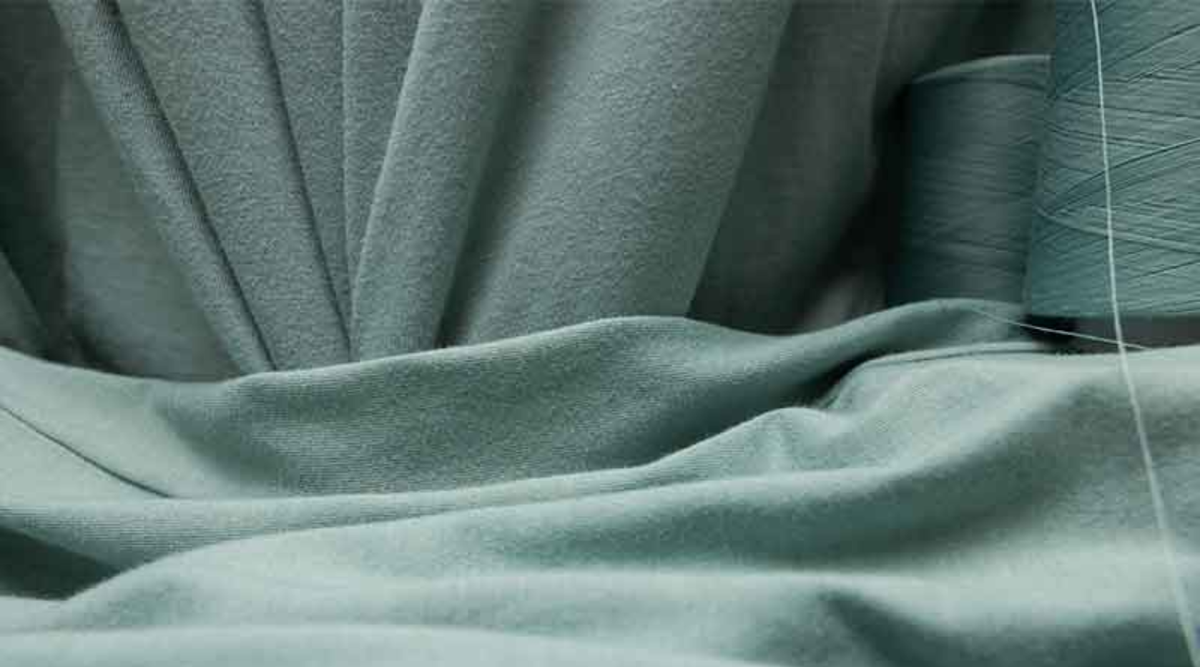
Our 1810 is made from 100% carded ring-spun cotton with documented construction specs: 24 singles, 5.6 oz per square yard (185 GSM). Those numbers determine how your press settings get calibrated and whether they'll need to change mid-run.
When fabric weight remains consistent from unit to unit, your flash and cure settings hold. When it drifts between lots, you're adjusting on the fly during a run where every minute of downtime carries a real cost. Good quality blanks take that problem off the table before it starts.
Surface Smoothness Determines What Your Print Looks Like at Scale
At low volume, a little variation in surface texture is manageable. At 2,000 units overnight, it turns into a spoilage problem. An uneven surface causes three issues that scale with volume:
- Ink pooling on screen print
- Halftone breakdown in finer detail areas
- Edge bleed that's fine on 50 shirts, but not across a complete run
Ring-spun cotton has a tighter knit than open-end spun cotton, and the tighter knit gives plastisol and water-based inks a consistent surface to adhere to, run after run. If you care about print method compatibility and surface performance, this isn't a secondary detail. It's the foundation of print quality at volume.
Our 1810's tubular construction takes this distinction further. Tubular means there's no side seam, so the print surface stays uninterrupted and uniform across every unit. It matters when you're loading platens at speed and can't stop to account for seam position.
The Real Cost of a Remake Run in Hot-Market Printing
The math on cheap blanks versus quality blank T-shirts shifts fast once you factor in spoilage. A 2% to 3% spoilage rate on a 2,000-unit run means 40 to 60 reprints, which is not a rounding error. It’s reprint time, re-pressing, ink, and on a hot-market job, maybe a missed delivery window.
Run those numbers, and the per-unit premium on quality blanks stops looking expensive. It starts becoming risk management.
Our whole philosophy is based on eliminating the disposable shirt. A shirt designed to last is also a shirt built to print right the first time, and both come from the same commitment to fabric construction and quality control at the manufacturing stage.
Collar and Construction Integrity Through Hours of Heat Exposure
A hot-market run keeps your press hot for hours, and cheap collars distort under that kind of extended heat, especially on high-volume jobs where the curing temperature must stay consistent across thousands of units.
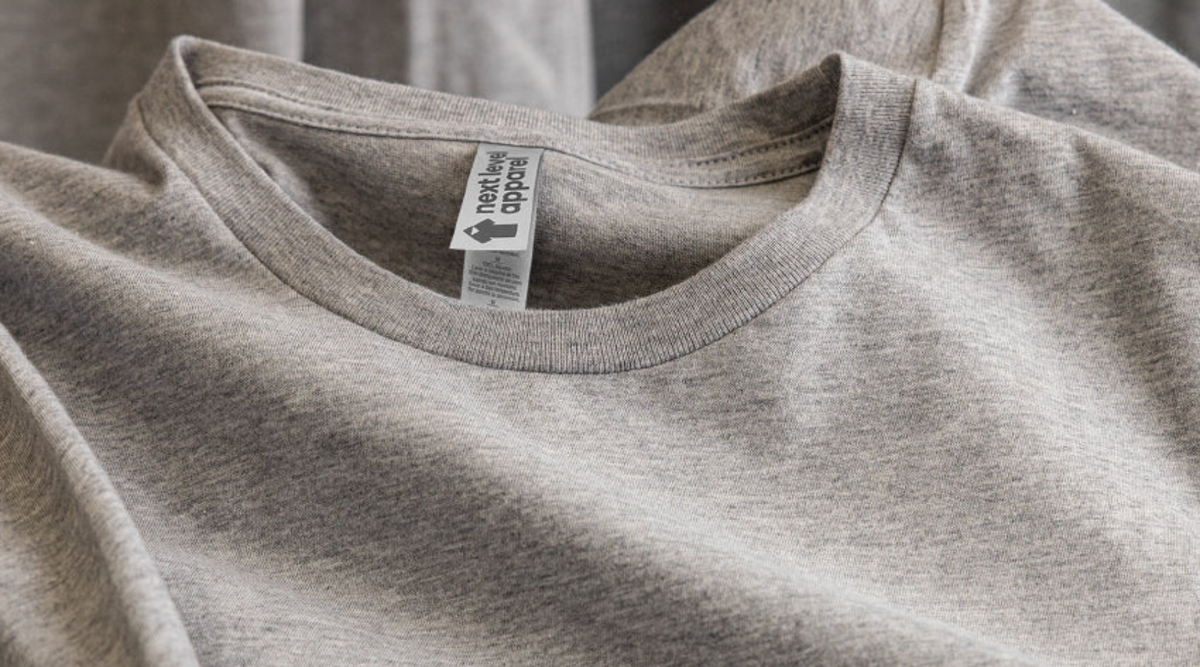
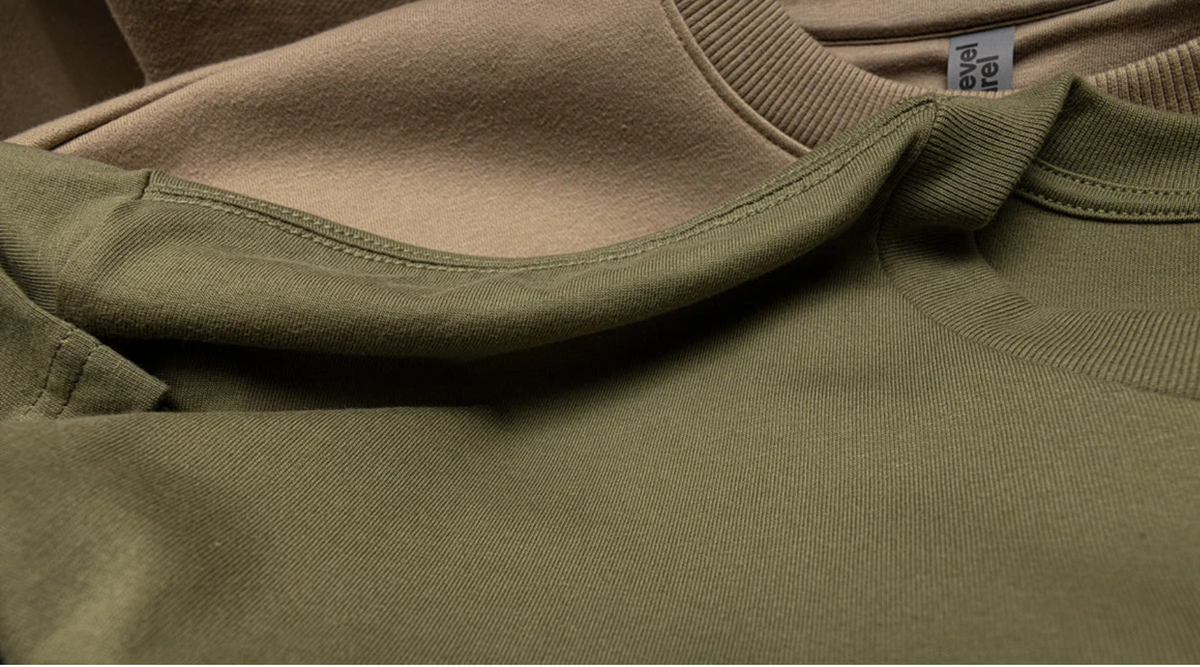
Our 1810 uses a 1x1 rib neckband with shoulder-to-shoulder binding. This construction retains its shape through repeated heat exposure in a way a standard collar on a low-cost blank just won't.
The tear-away label clears out label-printing complications and removes heat-transfer interference on the back neck, so it’s one less variable to track during a fast-moving run.
If you're running direct-to-garment (DTG), consistent pretreating behavior on 100% carded ring-spun cotton means you aren't adjusting pretreatment volume between units. And because the construction is tubular, there's no side seam to navigate on the platen, which means faster loading and higher throughput when every hour counts.
Color Consistency Across a Large Run Is Not Optional
Hot-market jobs often call for hundreds or thousands of units in a single colorway. If the dye lots drift between pallets, the finished product shows it, and in a direct-to-fan retail setting, that visible inconsistency reflects negatively on the brand behind the event, and not just the decorator who ran the job.
Our 1810 comes in 21 colorways, all produced with consistent dye quality across lots. This stability keeps ink behavior predictable no matter which unit comes off the pallet, so your color matching holds from the first shirt to the last.
Before you kick off a hot-market program, it's worth reviewing our Next Level Apparel Color Guide as a pre-production planning tool, especially for jobs where the event branding depends on precise color accuracy.
Speed-to-Print Readiness Starts Before the First Shirt Hits the Press
Every step you cut from pre-production is time you get back on the press, and we designed the 1810 with that in mind.
Here's what that looks like in practice:
- Tear-away labels eliminate a pre-production step and prevent heat-transfer interference on the back neck.
- Consistent 100% carded ring-spun cotton gives DTG operators predictable pretreating behavior, with no adjustments between units.
- Tubular construction means there is no side seam to navigate on the platen, so loading is faster and throughput is higher.
- Consistent fabric weight keeps your calibrated press settings calibrated across the entire run.
These are not premium add-ons but rather the baseline for production-level performance at hot-market speed.
The Next Level Apparel 1810 Is The Operationally Correct Choice for Hot-Market Work
Think of the 1810 less as a premium upgrade over commodity blanks and more as the blank that takes away the variables you can't afford when the clock is running.
A blank that performs identically from unit one to unit 2,000 isn't a luxury on a hot-market job. It's the baseline for running that job right. Once the event window closes and the demand is gone, you can’t recover what you lost to spoilage, remakes, or a missed delivery.
Choosing a good blank for hot-market work comes down to more than just the per-unit price. It's about the total cost of the run and the cost of getting that run wrong.
Frequently Asked Questions About Hot-Market Printing and Blank Quality
What makes a blank T-shirt suitable for hot-market printing?
A suitable blank has consistent fabric weight, documented construction specs, a uniform surface texture, and structural integrity through repeated heat exposure. Lot-to-lot consistency matters most: A blank that behaves the same from the first unit to the last keeps your press settings calibrated and your spoilage rate low.
Why does tubular construction matter for high-volume screen printing?
Tubular construction eliminates the side seam, giving you an uninterrupted, uniform print surface across every unit. At high volume, removing the side seam from the equation also speeds up platen loading, which is a real throughput gain when you're running thousands of units overnight.
How does fabric weight affect flash and cure settings in hot-market runs?
Fabric weight determines how much heat the garment absorbs and how quickly it reaches cure temperature. When that weight stays consistent across a run, your press settings hold. When it drifts between lots, you're adjusting mid-run, which adds time and risk to a job that has neither to spare.
Is ring-spun cotton better than standard cotton for DTG printing?
Yes. Ring-spun cotton has a tighter, smoother surface than open-end spun cotton, so you get more consistent ink absorption and better pretreating behavior for DTG. On a hot-market run, this consistency means you're not stopping to adjust pretreatment volume between units.
Ready to Spec the Right Blank for Your Next Hot-Market Program?
Our 1810 Ideal Tubular T-Shirt is made for production environments where consistency isn't optional. If you're running high-volume, time-sensitive jobs and want to take the blank off your list of risks, this is where to start.
Visit the Next Level Apparel 1810 Product Page to review full construction specs and available colorways, then browse the complete wholesale T-shirt line in the Next Level Apparel 2025 Catalog to plan your next program.
Leave a comment
All comments are moderated before being published.
This site is protected by hCaptcha and the hCaptcha Privacy Policy and Terms of Service apply.